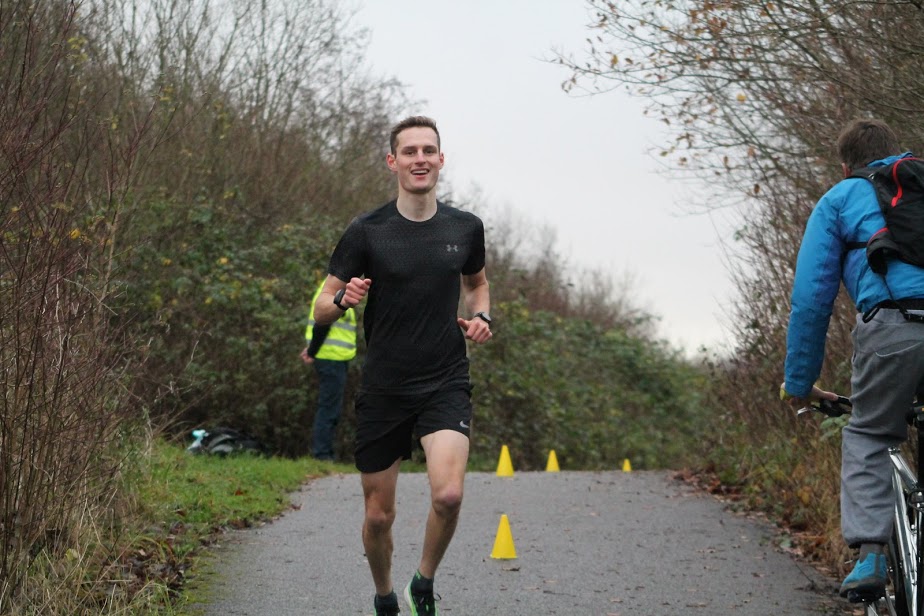
I have been training and racing in endurance sports for nearly four years now. Not a huge amount of time, granted, but you could say that I am no stranger to suffering – it has become a simple fact of life in the sports that I partake. As endurance athletes reading this, I am sure you will be able to relate: grinding out the last 5 minutes of your FTP test despite the searing pain in your legs, or perhaps the very different yet equally unbearable sense of total depletion at the back end of an Ironman Triathlon. For longer than I have been racing I have been aware of the massive impact that ‘mental toughness’ can have on performance. Indeed I have read about the subject in Matt Fitzgerald’s How Bad Do You Want It?. Despite all of this, being able to call upon ones own mental toughness is much easier to talk about than it is to action.
Of all things, it was an effort at a recent Parkrun that taught me a few things about this so-called ‘mental fitness’.
For the uninitiated, a Parkrun is a weekly 5k run on Saturday mornings from thousands of locations worldwide – particularly popular in the UK and Australasia. A couple of weeks ago, I ran my local Parkrun in a personal best time of 16 minutes and 39 seconds. Though far from touching the blistering pace of elite runners, for me 16:39 was not just a PB, it eclipsed my previous best (set only four weeks prior) by 35 seconds. And for the record, when I set the slower time of 17:14 I was, at least in my mind, ‘giving it my all’. So what was at play for my improvement?
Firstly, I have been running more. The combination of the cold and wet winter in the UK (rather unappealing cycling conditions), and my new goals for the coming season have led to an increase in my weekly running mileage. The fitness increase due to that cannot be ignored. But it can also easily be overstated. My experience in cycling, running and triathlon points to the fact that such a large improvement in a matter of weeks is likely due to something much greater than fitness alone.
Plus, something was different that morning. Which is what leads me to believe that it was almost entirely mental.
That morning, I woke up and straight away knew that the sub 17 was happening. No more “I’m just going to give it my best and see how I get on”, rather “I’m going to make sure it happens, no matter what”. I didn’t give my body the opportunity to say no. This positive self-talk really has does have its place in priming yourself for optimum performance. After all, how could I be expected to run a new best if I didn’t truly believe that I was going to do it in the first place?
On that note, I didn’t shy away from the obvious either. A sub 17 minute 5k wasn’t going to be easy, it was going to hurt. The best thing that you can do is embrace that inevitability whole-heartedly. That way, the body will not be so shocked when it does find itself in the hurt box. It may sound a little masochistic, but ultimately it is this mind-body challenge that brings us all back to endurance sports day after day.
During the run I learnt a few things as well.
First things first, just because it starts to hurt, doesn’t mean that you have to slow down or stop. You’d be surprised what the body is capable of with some control over the mind. When it does starts to hurt, acknowledge the pain, give it a nod. But try to continue with your output for now, remaining hyper-aware of your pain levels. Is it actually getting any worse, or does it stabilise at a certain pace or power? And look, I am no superhuman at all. Of course I don’t have complete control over the mind-body interface. I still have days where I have no mental capacity to suffer. But mere awareness of the ‘chimp’ in your brain that makes you want to stop may be enough. Always be asking yourself: “Do I need to slow down, or do I just want to?”.
Finally, relax! Easier said than done, I know. I am always catching myself making it hurt more than it really ought to. Whether this be through grimacing in the face, carrying the shoulders and neck with a ton of tension, clenching fists, or breathing shallow and rapidly. All of these things serve only to raise your rate of perceived exertion, never mind lowering your style and panache. Again, when it starts to hurt just check-in with yourself. Am I making this more difficult than I have to? Relax any muscles that aren’t serving your output; breathe deeply and controlled from the diaphragm; find your zone, your flow state; and make it look like you aren’t suffering at all.
With all this said and done, you’d be forgiven for thinking that I have some crazy approach to training – that everything should be a sufferfest, be painful. Quite the opposite. These sort of mental efforts should only be used sparingly, though at regular intervals, to free your cognitive load and make them a true performance enhancer come race day, whilst still staying in touch with where your physical limits are. With that in mind, don’t go max chaff at parkrun every week. It’s only 5k, so you may not overdo it physically, but you may just burn through your psychological matches quicker than you had hoped.
The key take aways:
- Positive self-talk: tell yourself that you are going to achieve your goal
- Prepare yourself for the fact that it’s going to hurt
- Just because it hurts, doesn’t mean you have to stop
- Stop carrying tension: relax, breathe, find your zone, make it look easy
- Don’t go all in every week – for mind as well as body
 Duathlon Dan
It is an excellent article, with good insight that outline the issues very well, congrats and thanks !🙏
LikeLike